
Understanding movement starts with understanding the horse.
Every stride involves a complex relationship between muscles, joints, tendons and supporting structures. Changes in comfort, mobility or muscular balance can influence how a horse moves and performs.
KS Equine takes an individual approach, considering the whole horse, its workload, movement and history.
Explore the horse
Select a region to read what it contributes to movement, which structures sit within it, what an owner may notice, and where KS Equine may be able to help.
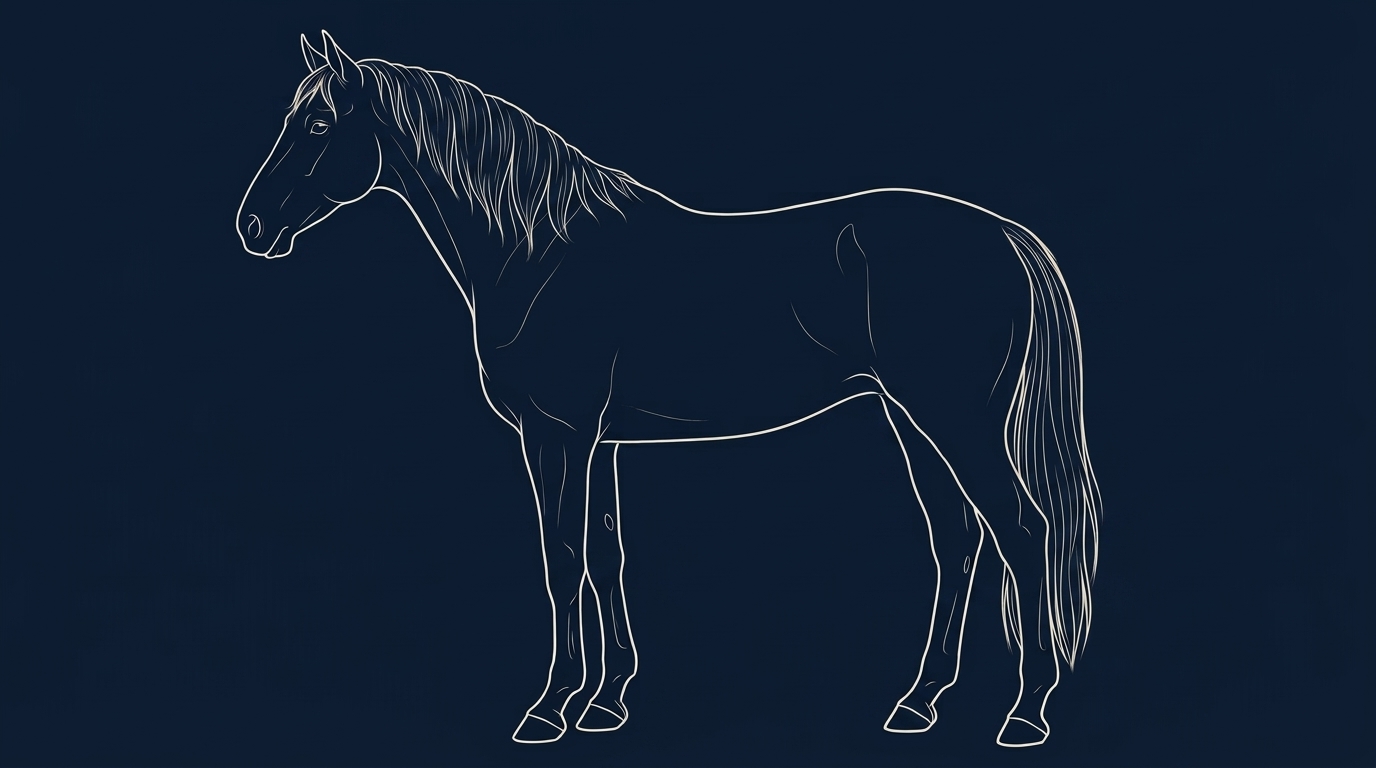
A simplified side-view line drawing of a horse, divided into seven selectable regions: poll and neck, shoulder, back and topline, core and trunk, hindquarters, forelimbs and hindlimbs. Each region can also be selected from the list of buttons below the drawing.
No region selected
Regions
Select a region of the horse
Select a region to read what it contributes to movement, which structures sit within it, what an owner may notice, and where KS Equine may be able to help.
Inside the lower limb
An original, simplified orientation diagram of the lower forelimb. Select a category to see the structures that belong to it.
Bones
The bony column carries and transfers load down through the limb to the ground.
- carpus (knee)
- accessory carpal bone
- cannon bone
- splint bones
- sesamoid bones
- pastern bones
The lower limb is a highly specialised system of bones, tendons, ligaments and supporting structures working together to manage movement and load.
This information is educational and does not replace veterinary assessment or diagnosis.
The muscles behind movement
A simplified view of some of the superficial muscles involved in posture, movement and performance. Select a region to explore the principal muscular areas associated with it.

Stylised lateral illustration of a horse showing simplified superficial muscular regions.
Regions
Select a region
This illustration provides general anatomical orientation. It does not identify pain, injury or dysfunction and does not replace veterinary assessment.
The pelvis, sacrum and tail
A simplified educational view of the structures around the horse’s pelvis, lower spine and tail, together with examples of tail carriage that an owner may observe.
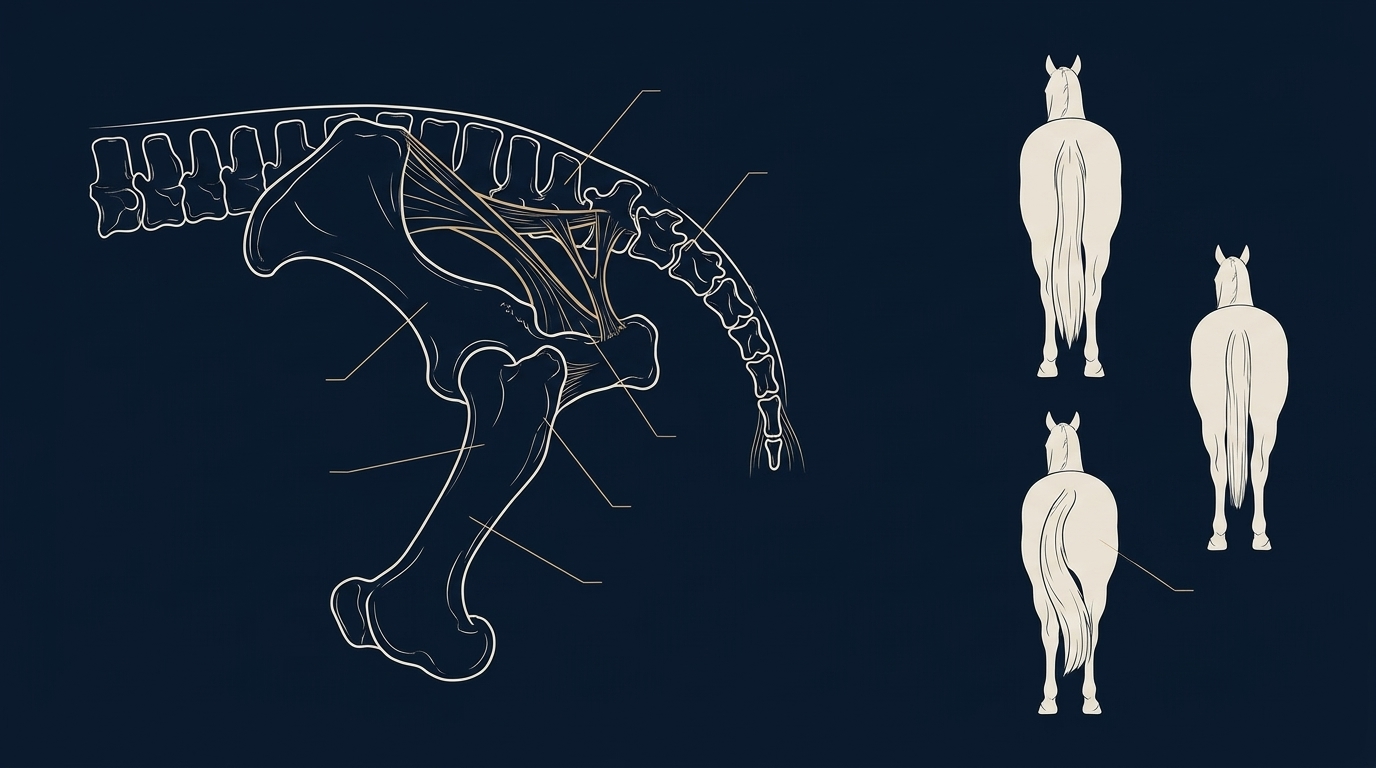
Anatomical key
- Lumbar vertebrae
- Ilium
- Sacrum
- Sacroiliac joint
- Dorsal sacroiliac ligaments
- Ventral sacroiliac ligament
- Sacrosciatic ligament
- Ischium
- Femur
- Coccygeal vertebrae
Tail-carriage views
Tail carriage can form part of observing how a horse uses its body. A persistent or sudden change may be worth noting, but tail position alone cannot identify its cause or provide a diagnosis.
Simplified educational illustration. Anatomical orientation only.
Where KS Equine may support the horse
Five areas of work, each considered in the context of the individual horse, its workload and its history.
- 01
Alignment & Movement
Assessing movement and muscular balance to support comfortable, efficient function.
- 02
Performance Support
Supporting mobility, flexibility and muscular condition for horses in work and competition.
- 03
Rehabilitation Support
Complementary therapeutic support as part of an appropriate rehabilitation programme.
Where injury, surgery or veterinary treatment is involved, rehabilitation support should complement appropriate veterinary guidance.
- 04
Maintenance & Preventative Care
Regular treatment designed to support ongoing mobility, comfort and muscular condition.
Regular treatment is intended to support condition and comfort. It is not a guarantee against injury or medical conditions.
- 05
Individualised Treatment
Every horse is different. Treatment should reflect the individual horse, workload, history and current needs.
Your horse cannot tell you where it hurts.Movement often can.
Small changes in movement, behaviour or performance can sometimes be worth paying attention to.
- 01
Stiffness
Taking longer to loosen, or feeling stickier than usual at the start of work.
- 02
Reduced flexibility
Less range through the neck, back or limbs than the horse usually offers.
- 03
Changes in stride
A shorter, longer or altered rhythm compared with the horse's normal.
- 04
Difficulty engaging
Finding it harder to step under behind or work through the back.
- 05
Muscular sensitivity
Areas that feel tight, uneven or reactive under the hand.
- 06
Changes in performance
Work that used to come easily now taking more effort or more asking.
- 07
Grooming & tacking up
Reactions during grooming, rugging or tacking up that are new for the horse.
- 08
Left and right differences
A noticeable difference between the two sides in how the horse moves.
- 09
After increased workload
Changes appearing after a step up in training, competing or hunting.
- 10
Returning to work
Difficulty returning comfortably to normal work after time off.
Every horse is different. If you are concerned about pain, lameness, injury or sudden changes in your horse, veterinary assessment may be appropriate.
Every horse moves differently.
Understanding the individual horse is at the heart of the KS Equine approach.